When an FDA inspection investigator walks through your doors, they are evaluating the integrity of your entire facility. While workforce training is only one component of a comprehensive inspection, it often serves as the “litmus test” for your broader safety culture. They aren’t just looking for your training logs; they are looking for the “why” and the “how” behind your staff’s competency to determine if your operational guardrails are actually holding.
For many FSQA leaders, the audit is the ultimate stress test of their internal systems. Yet, a common trap in the food and beverage industry is the belief that a stack of signed papers constitutes a “program.” In reality, an investigator uses training records as a gateway to probe your deeper systems. Their goal is to determine if your facility’s safety culture is an active, living practice or merely a static administrative facade.
If your training program cannot prove that an employee actually understood the material—and that the material was current at the time of their last shift—it creates a “loose thread” that an investigator will pull to uncover broader systemic failures.
1. Shift Your Lens: From “Audit Proof” to “Inspection Ready”
A common sentiment in facilities that have enjoyed long-term stability is: “We’ve never failed an audit.”
This is a dangerous form of normalcy bias. An audit is a snapshot in time; an FDA inspection is an evaluation of a living ecosystem. Relying on past success is often an oversimplification of current risk. Auditors are increasingly moving beyond the “checkbox” to ask frontline workers direct questions about the “why” behind a safety protocol. They aren’t just auditing a training file; they are auditing the operator’s reality.
They are looking for the disconnect between what your SOPs say and what your staff actually does when the pressure is on. If your workforce training is static, workers will recite what they heard once in a yearly orientation—a memory that has likely faded or been distorted by daily shortcuts.
When an operator falters under questioning, the investigator doesn’t just see a training gap; they see a facility-wide compliance risk. True inspection readiness requires a system that prioritizes active recall and verifiable understanding, ensuring that when an investigator stands over an operator’s shoulder, the “muscle memory” of compliance is visible.
2. The Speed of Specialized Content: Rebuilding Without the Overwhelm
The most frequent resistance to upgrading a training program is operational: “We don’t have time to rebuild training.”
This fear of disruption is valid. In a high-volume facility, taking a line down for a day of retraining feels like a productivity death sentence. It’s the primary reason many facilities stick with outdated, ineffective methods—they prioritize immediate throughput over long-term defensibility.
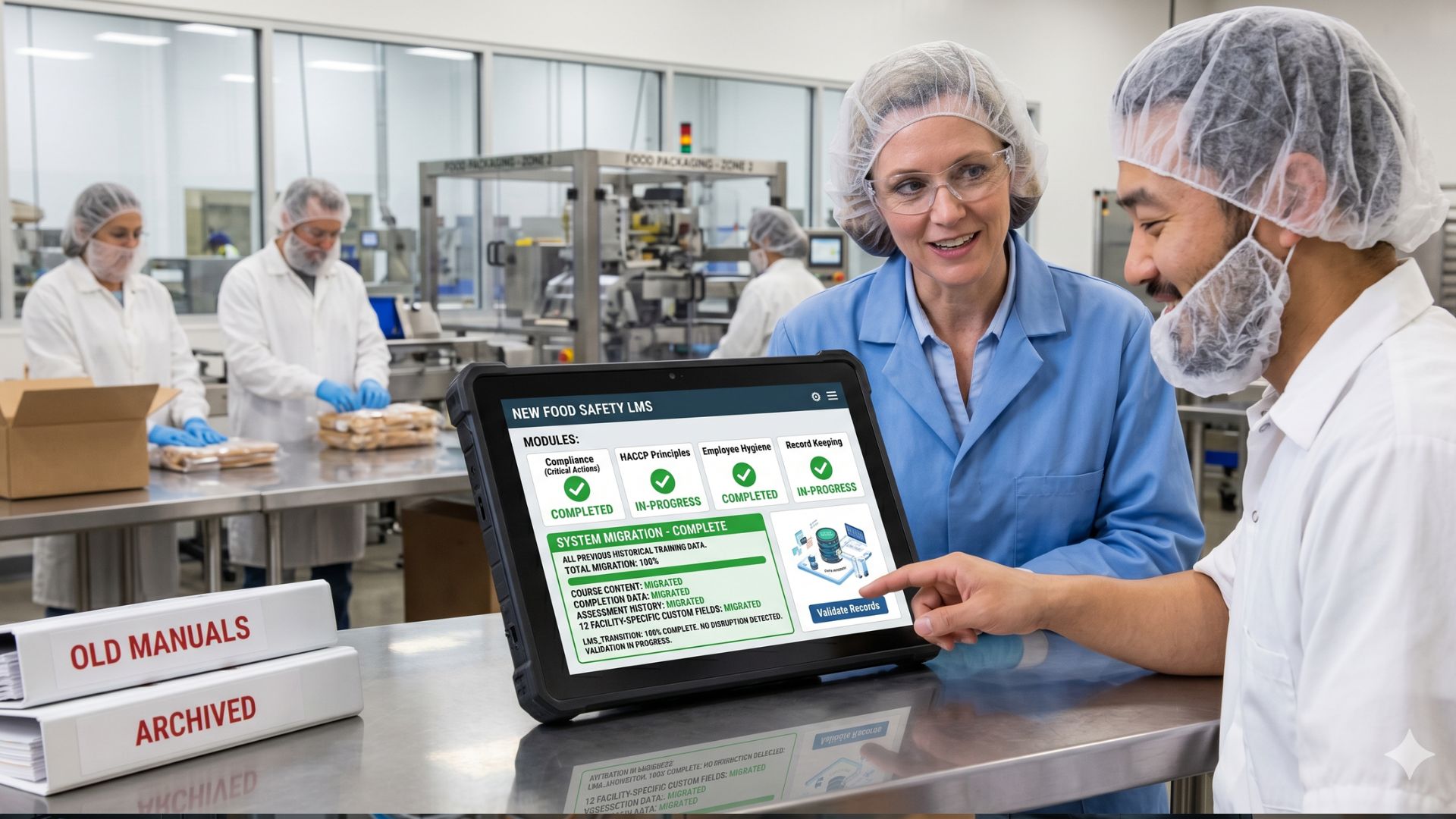
With the right toolset, you don’t have to start from scratch. In today’s world, you can leverage AI-powered course creation software to take existing, dense SOPs and transform them into much more accessible eLearning modules for site-specific operational training. Importantly, by replacing paper SOPs with digital courses, you can document completion and understanding, and even add an observation of the employee performing the task. By making training a seamless part of the workflow, you ensure that the documentation investigators check is always a true reflection of current, active competence.
3. Competency Architecture: The Three Pillars of Defense
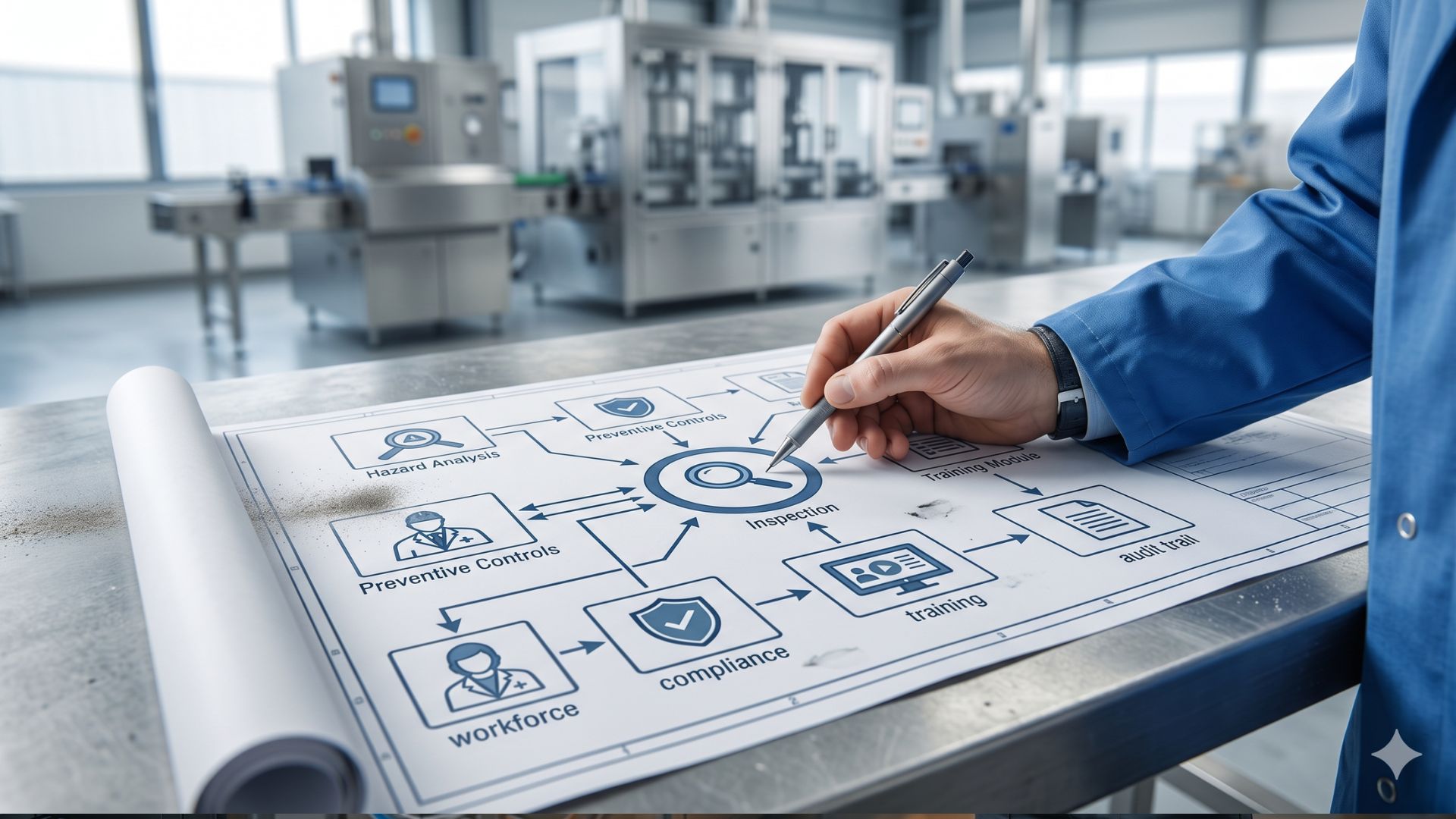
To withstand the scrutiny of an audit or inspection, your documentation must bridge the gap between “HR records” and “operational reality”:
- Granular Version Control: You must be able to show exactly which version of an SOP an employee was trained on at any given moment. If you updated your HACCP plan in June to address a new biological hazard, but your training records still reflect the April version, you have a critical traceability gap that signals a failure in your facility’s change management system.
- The “Nudge” Economy: Human error in administration is a top cause of audit findings. Instead of relying on manual follow-ups, your system should automatically flag upcoming expirations. This proactive approach ensures that training lapses never become the “red flag” that invites an investigator to dig deeper into your production logs.
- Real-Time Reporting: During an inspection, speed equals confidence. Hesitation or a “let me get back to you on that” often invites deeper digging. Being able to pull a comprehensive training report in under 60 seconds with a robust, user-friendly LMS signals to an investigator that your entire facility is managed with professional precision and that your data is integrity-tested.
4. Proving the Payoff: The Analytical Reality of Training ROI
At the executive level, the question is always: “How do we measure training ROI?”
If training is viewed as a “cost center”—an unfortunate administrative tax—it will always be underfunded. But when you tie workforce training to measurable operational outcomes, the financial payoff becomes impossible to ignore.
Effective, specialized training is directly correlated to a reduction in recordable incidents and significantly reduces downtime caused by operational errors. When a worker truly understands the “why” behind equipment sanitation, the risk of a contamination event drops dramatically. Ultimately, a specialized LMS is “facility insurance.” It protects the entire operation from the massive, unpredictable costs of regulatory intervention and the catastrophic brand damage that follows a public recall triggered by a single operator’s error.
Implementation: The Path Forward
Surviving an FDA inspection isn’t about having perfect training logs; it’s about having a facility that demonstrates total control. Designing a program that withstands scrutiny is about implementing a system that manages the complexity for you. By leveraging modern training tools, like the SkillUp workforce training platform, you can transition from a reactive “hope-based” strategy to a proactive, defensible competency engine. You ensure that when the investigator arrives, your training records aren’t a liability—they are the strongest evidence of your facility’s safety culture.
Build Your Defensible Training Blueprint
See How SkillUp™ Automates Compliance