

Artificial intelligence is rapidly reshaping workforce training. Efforts that once consumed days or weeks can now be completed in hours, even minutes. Standard operating procedures (SOPs) can become training courses, assessments can be generated automatically, and existing content can be updated faster than ever before.
For training leaders facing increasing demands with limited resources and limited time for workforce development, AI offers a compelling opportunity. But as AI adoption accelerates, many food manufacturers are asking an important question:
If tools like ChatGPT and Claude are already available, why would we need AI-powered course creation inside our learning management system?
The answer lies in understanding the difference between creating content and creating training courses.
Why AI Has Captured the Attention of Food Manufacturers
Before diving into the details, let’s step back and look at the big picture. Food manufacturers face numerous training challenges. According to the 2026 Global Food Safety Training Survey, the industry’s biggest challenges include finding time for training, creating engaging training, assessing effectiveness, creating content, and keeping materials up to date.
At the same time, the research confirms that training quality has a measurable impact on operational performance. Facilities with above-average training programs are:
- 12 times more likely to achieve strong SOP adherence
- 5 times more likely to prevent incidents before they occur
- 109% more likely to improve productivity
The challenge, of course, is that creating and maintaining high-quality training requires significant time and resources.
This is where AI can help.
The survey identified several practical applications of AI in workforce training, including accelerating content creation, enhancing assessments, improving multilingual training, reducing administrative workload, and expanding professional development opportunities.
Organizations already leveraging AI are seeing promising results. Facilities using AI in training were found to be 33% more likely to report positive productivity impacts and 51% more likely to report positive employee retention impacts than organizations with no plans to adopt AI.
The benefits are real. But not all AI approaches deliver the same value.
The Common Assumption: “We Can Just Use ChatGPT”
For many organizations, the first step into AI is experimenting with popular tools such as ChatGPT, Claude, Gemini, or Microsoft Copilot. These platforms are excellent at generating text. Upload an SOP and they can quickly produce:
- Training outlines
- Learning objectives
- Quiz questions
- Translation drafts
- Instructor notes
From a content creation perspective, this can save valuable time. However, many food manufacturers quickly discover that generating words is only the beginning of the process.
The objective isn’t to create documents. The objective is to create effective training courses that are interactive, designed for frontline workers, are native to your learning management system (LMS), and can be automatically tracked for completion, comprehension, and correct application on the production floor.
Content Creation Is Not Course Creation: The Strength of AI-powered LMS
This is the critical distinction that often gets overlooked. Generic AI platforms create content. Purpose-built AI course authoring tools create LMS-ready courses. Better yet, the course creation is built into the LMS.
Consider a food safety manager who uploads an allergen-control SOP into ChatGPT. The AI may generate a solid training outline and a list of quiz questions within seconds. However, the organization still needs to:
- Review the content for accuracy.
- Format into a course.
- Create learning interactions.
- Configure learner navigation.
- Ensure consistency with other training materials.
- Publish the course in a format supported by an LMS.
- Upload and test the course.
- Assign training and monitor completion.
- Maintain governance so only one correct version is used.
- Make updates to courses easily when needed.
The AI helped create the raw material, but the majority of the work still remains.
This is where purpose-built platforms such as SkillUp AI Create differ significantly. The majority of the above list needs to be done within your learning platform. Rather than generating content assets alone, AI Create is designed to transform source materials into LMS-ready eLearning courses that can be deployed, assigned, tracked, and documented within the training ecosystem.
That’s a fundamentally different outcome to develop effective training.
Why LMS-Ready Matters
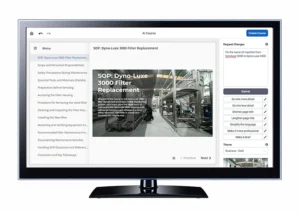
Food manufacturing training does not end when content is created. Training must be delivered, documented, and audit-ready. A Word document is not a training course. A PowerPoint is not a training course. Even a video is not a training course.
Training programs ultimately require structured learning experiences that can be delivered and tracked through an LMS. This requires that courses be developed in formats such as SCORM or xAPI, something Claude, ChatGPT, and other standard AI tools simply cannot do.
This distinction becomes especially important in regulated industries where organizations must demonstrate that employees completed training and understood the material. Generic AI tools stop at content generation. Purpose-built AI course creation platforms continue through the entire training development, delivery, and documentation process.
For organizations that regularly create training from SOPs, work instructions, quality procedures, safety requirements, and compliance documents, this can dramatically reduce development time while increasing consistency.
Accuracy Still Requires Oversight and Workflow Collaboration
The 2026 Global Food Safety Training Survey found that accuracy and reliability are among the most significant concerns organizations have regarding AI adoption. Nearly half of respondents identified accuracy as a barrier.
This concern applies whether organizations use ChatGPT, Claude, or any other AI system. AI-generated output should always be reviewed by subject matter experts before deployment. Food manufacturers cannot afford procedural inaccuracies related to food safety, quality, sanitation, allergens, workplace safety, or regulatory compliance. The best use of AI is not to replace expert judgment. It is to help experts work faster.
Purpose-built AI systems support this approach by accelerating course development while allowing organizations to maintain control over review and approval processes. Collaboration is essential. Platforms like SkillUp are designed with workflows specific to training course authoring baked into the process. Feedback reviews, approvals, and ongoing governance are centralized, streamlined, and secure.
Consistency Matters More Than Many Organizations Realize
Another challenge with generic AI tools is consistency. This comes in two forms: visual design and content.
Starting with design, learning scientists and academies, including the Digital Learning Institute, strongly advocate for consistent design in training materials. Consistent visual layouts and styles, predictable navigation, and standardized content structures reduce extraneous cognitive load, helping learners process core instructional content rather than the brain unconsciously wasting mental effort on discerning the design and layout.
This desired consistency is easy to achieve using branded templates within purpose-built training AI. The same can’t be said of ChatGPT, Claude, et al. As anyone experienced with generative AI can attest, even when providing templates as input, these general AI tools will provide endless hours of frustration when driving for design accuracy and consistency — even for the savviest AI users.
As for the instructional content itself, it is guaranteed that if five different supervisors use ChatGPT to create training on lockout/tagout procedures, each will receive different explanations, examples, and emphasis areas. While this may be true for purpose-built training AI tools as well, the key difference is the collaborative tools within these platforms, as outlined in previous section.
Over time, organizations leveraging Claude, Gemini, or ChatGPT may end up with:
- Different versions of the same training
- Inconsistent messaging
- Duplicated development efforts
- Uneven learner experiences across facilities
Whereas a centralized AI system designed specifically for course creation helps standardize development processes and establish governance around how training is created and maintained. Instead of everyone creating content differently, the organization creates training through a repeatable framework.
In food manufacturing, consistency is directly tied to compliance and operational performance.
AI LMS Enhances Security and Data Privacy
Food manufacturers often possess sensitive operational documents, proprietary processes, customer requirements, quality procedures, and internal production information.
When employees independently upload these materials into external AI tools, organizations may face questions about:
- Data governance
- Intellectual property protection
- Information security
- Internal AI policies
A closed AI training environment provides greater control over how training materials are used, managed, and converted into learning content. While ChatGPT, Claude, etc. have corporate license options with stronger security features (for a heftier price) than standard subscriptions, the risk of various settings allowing for information flowing back into their large language model (LLM) database is always present.
For many organizations, this governance capability is just as important as the AI itself.
The Future Is Purpose-built AI Course Creator
The Global Food Safety Training Survey found that many facilities remain stuck at “sufficient” training rather than achieving training excellence. Yet facilities with stronger training programs consistently outperform their peers in safety, compliance, productivity, engagement, and retention.
AI has the potential to help close that gap. And the food industry remains optimistic about AI’s role in workforce development. In fact, survey respondents were nearly seven times more likely to believe AI will have a positive impact on training than a negative one.
The question is no longer whether AI belongs in workforce training. The question is how organizations can extract the greatest value from it. Generic AI tools can help training teams draft content. Purpose-built AI course creation platforms can do this and so much more, helping organizations create, deliver, manage, track, and document training.
In an industry where training quality directly impacts food safety, compliance, productivity, and employee retention, that difference matters.
If you’re ready to accelerate your facility’s AI journey, read more about SkillUp’s AI Create features, or to schedule a demo, here: https://www.registrarcorp.com/workforce-training/course-creation-software/.