The food manufacturing industry faces enormous pressure. Companies must maintain food safety standards, meet production goals, pass audits, and retain employees in an increasingly competitive labor market. At the same time, workforce demographics are changing and employee turnover remains a persistent challenge.
These realities have exposed a growing problem: many food manufacturers are still relying on outdated onboarding processes, paper-based training records, and inconsistent on-the-job training methods that were never designed for today’s workforce. Even those that are utilizing a learning management system (LMS) are often relying on decades-old platforms, which brings its own set of issues and inefficiencies.
To build safer facilities, reduce risk, and improve retention, organizations must rethink their approach to food manufacturing training and adopt modern solutions that scale with operational demands.
The Growing Complexity of Food Manufacturing Training
Every employee, whether they work in production, sanitation, maintenance, warehousing, or quality assurance, plays a role in protecting food safety and product quality standards. A single mistake can contribute to contamination events, recalls, injuries, or audit findings. At the same time, employers are expected to provide role-specific training and maintain documentation that demonstrates employee competency and comprehension.
The challenge is that most facilities are trying to accomplish all of this while facing workforce disruptions that make training significantly more difficult.
Challenge #1: High Employee Turnover
Turnover remains one of the most expensive workforce challenges in manufacturing.
When employees leave, institutional knowledge leaves with them. New hires must be onboarded quickly, trained effectively, and prepared to perform safely without disrupting production schedules.
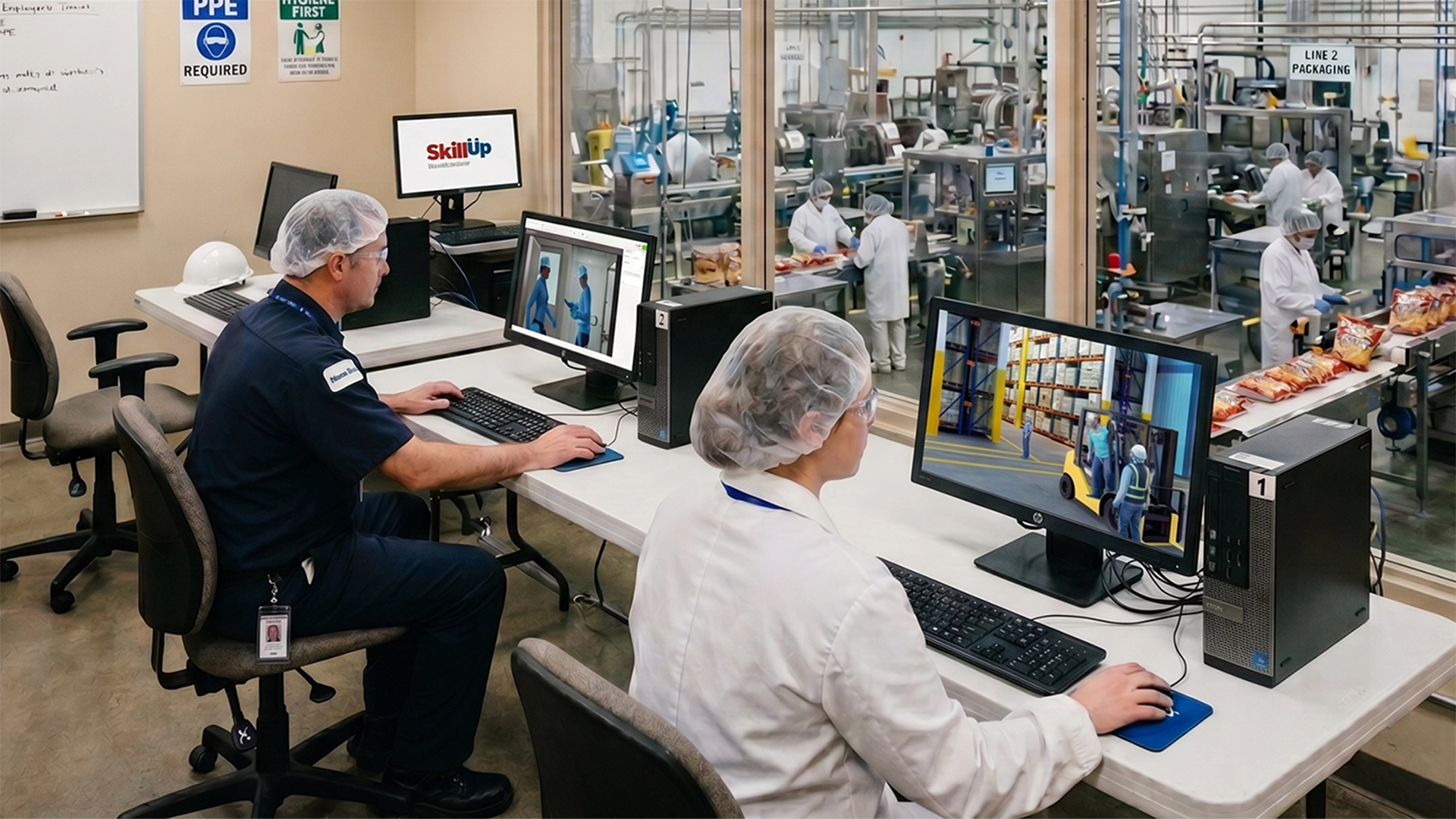
A modern approach to employee training in food manufacturing provides structure and repeatability. Automated learning plans, role-specific assignments, and digital progress tracking help ensure every employee receives the same foundational training regardless of shift, facility, or trainer. A modern LMS, such as the SkillUp workforce training platform, enables structured onboarding programs, tracks learner progress, and streamlines observations and validations to identify potential gaps on the production floor.
Challenge #2: Production Pressure Reduces Training Time
Food manufacturers are constantly balancing workforce development against operational demands. In fact, finding time to provide adequate training is consistently ranked the highest challenge by food manufacturers in the Global Food Safety Training Survey.
Production schedules do not stop because a new employee needs training. Supervisors often struggle to pull employees away from production lines long enough to complete training initiatives. As a result, training is frequently compressed, delayed, or treated as a one-time event rather than an ongoing process.
This creates a dangerous cycle. Less training can lead to more mistakes, more rework, more quality issues, and more productivity losses.
Effective manufacturing training programs recognize that employees learn best when content is efficient, relevant, and easy to access. Short-format learning experiences, mobile access, and role-based learning paths make it easier to fit training into real manufacturing environments.
SkillUp’s interactive training library uses interactive microlearning courses designed to keep learners engaged while minimizing disruptions to production schedules. Courses are intentionally concise to help employees absorb and retain information without requiring significant time away from operational responsibilities. Highly interactive exercises throughout the courses provide learn-by-doing scenarios that lock in the learning to be applied on the floor.
Challenge #3: Multilingual Workforces
Food manufacturing facilities increasingly rely on diverse workforces with varying language backgrounds.
The consequences of ineffective communication can be significant. Employees who do not fully understand food safety procedures, sanitation requirements, hazard controls, or workplace safety instructions may unknowingly increase operational risk.
Traditional training methods often rely heavily on printed documents, trainer explanations, and lengthy presentations. These formats can create comprehension challenges, especially when content is translated inconsistently or delivered differently across locations.
Modern food manufacturing training courses must be designed for engagement and accessibility. Digital learning platforms can provide standardized content across facilities while supporting multiple languages. SkillUp’s eLearning library, for example, delivers training in English, Spanish, and Canadian French, helping organizations provide consistent instruction to diverse teams. And SkillUp’s AI Create feature makes translation to additional languages faster and easier, within a secure platform rather than feeding data to open-source AI models.
Challenge #4: Food Safety Risks Continue to Evolve
Food safety requirements are not static. New risks emerge constantly, and organizations must ensure employees understand how to respond appropriately.
Employees need training on topics such as:
- Good Manufacturing Practices (GMPs)
- Allergen management
- Cleaning and sanitation
- Environmental monitoring
- Foreign material prevention
- HACCP principles
- Food safety culture
- Preventive controls
- Personal hygiene requirements
SkillUp’s comprehensive training library includes courses covering these and many other food safety topics relevant to frontline workers.
The challenge with traditional systems is maintaining content currency. Printed materials, binders, and manually managed presentations can quickly become outdated. Training departments may also struggle to create new training materials fast enough when procedures change.
Modern training platforms help solve this problem by centralizing content management and enabling faster content updates. SkillUp’s AI-powered course creation tool allows manufacturers to convert SOPs, documents, and other materials into training courses more rapidly than traditional development methods. And making minor updates when procedures change doesn’t become a major hassle, handled in minutes and centrally deployed to ensure no outdated materials remain in circulation.
Challenge #5: Audit Readiness and Documentation
One of the most persistent frustrations for training managers is proving that training actually occurred.
Food manufacturers must maintain documentation supporting workforce training efforts and employee competency. During audits or inspections, organizations may need immediate access to records showing who completed training, when they completed it, and how comprehension was verified.
Paper-based systems create several challenges:
- Missing records
- Inability to prove comprehension
- Incomplete or illegible sign-in sheets
- Data entry errors
- Time-consuming audits
- Difficulty identifying training gaps
- Limited visibility across multiple facilities
Digitized recordkeeping and automated documentation help organizations maintain training records and access detailed reports when needed. The system is designed to support audit readiness by reducing manual processes and simplifying access to training records.
For many organizations, eliminating paper records alone can significantly reduce administrative burden while improving confidence during inspections and certification audits.
Why Traditional Onboarding and Paper-Based Systems Fall Short
Today’s workforce demands more than compliance-driven training. Traditional approaches often focus on documenting attendance rather than improving performance. Employees sit through videos or presentations, sign paperwork, and complete checklists or multiple choice questions, but organizations have limited insight into engagement, comprehension, or long-term retention.
Meanwhile, supervisors spend significant time managing spreadsheets, filing records, chasing signatures, and coordinating training activities manually. The result is a system that consumes resources while delivering limited visibility into actual employee competency.
Modern training programs shift the focus from recordkeeping to workforce development.
Instead of asking, “Did the employee attend training?” manufacturers should be asking:
- Did the employee understand the material?
- Can the employee apply the knowledge on the job?
- Are there training gaps that need attention?
- How quickly can we onboard and develop new employees?
- Can we demonstrate competency during audits?
These questions require more sophisticated tools and more intentional training strategies. For those just getting started on this effort, the eBook: Building & Scaling a Modern Training Program has a helpful step-by-step guide.
How to Improve Food Manufacturing Employee Training
Organizations looking to modernize their training programs should focus on several key principles:
Standardize Training Across Locations
Training content should remain consistent across facilities, shifts, and departments to reduce variability and improve compliance.
Embrace Digital Learning
Digital delivery improves accessibility, reporting, scalability, and consistency while reducing administrative workload.
Use Role-based Learning Paths
Employees should receive training aligned to their specific responsibilities instead of generic content that may not apply to their jobs.
Track Progress and Competency
Training programs should provide visibility into completion rates, competency development, and areas requiring additional support.
Build Custom Training Quickly
Operational procedures evolve constantly. Training departments need efficient ways to convert SOPs, presentations, and internal knowledge into engaging learning experiences. SkillUp’s AI-powered course creation capabilities were developed to help accelerate this process.
Support Workforce Development
Training should extend beyond compliance. Cross-training, upskilling, and career development initiatives can contribute to employee engagement and retention. Modern platforms like SkillUp support competency tracking and workforce development efforts designed to help organizations grow internal talent.
The Future of Food Manufacturing Training
The most successful food manufacturers understand that training is no longer merely a compliance requirement. It is a strategic investment that influences food safety, workforce stability, productivity, audit performance, and employee engagement.
Organizations that continue relying on paper records, inconsistent onboarding, and outdated delivery methods may struggle to keep pace with workforce expectations and operational demands.
As workforce challenges continue to evolve, manufacturers that invest in effective, scalable food manufacturing training programs will be better positioned to build safer operations, retain employees, and maintain compliance with confidence.
Modern platforms such as SkillUp combine food safety content, workforce development tools, digital recordkeeping, learning management capabilities, and AI-powered course creation into a unified approach designed specifically for food manufacturers.
Learn more about SkillUp here.
Frequently Asked Questions About Food Manufacturing Training
What is food manufacturing training?
Food manufacturing training teaches employees the food safety, quality, sanitation, workplace safety, equipment, and role-specific procedures needed to work safely and consistently in a production environment. Effective programs also document understanding and verify correct employee application on the plant floor.
Why is training important in food manufacturing?
Training is important because every employee can affect food safety, product quality, audit readiness, and workplace safety. Consistent training helps reduce mistakes, improve compliance, support employee retention, and prepare teams to follow procedures correctly on the production floor.
What are the biggest food manufacturing training challenges?
Common challenges include high turnover, limited time for training, multilingual workforces, evolving food safety requirements, inconsistent onboarding, outdated content, and difficulty maintaining audit-ready training records.
How can food manufacturers improve employee training?
Food manufacturers can improve training by standardizing content, using digital learning tools, creating role-based learning paths, tracking completion and competency, supporting multiple languages, and keeping training materials current as procedures change.
How does an LMS help food manufacturers?
A modern LMS helps food manufacturers assign training, automate onboarding, track learner progress, verify comprehension, maintain records, and deliver consistent training across shifts, roles, and facilities.